0965 - Univalued Binary Tree
Description (leetcode)
A binary tree is uni-valued if every node in the tree has the same value.
Given the root of a binary tree, return true if the given tree is uni-valued, or false otherwise.
Example 1:
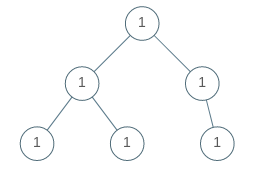
Input: root = [1,1,1,1,1,null,1]
Output: true
Example 2:
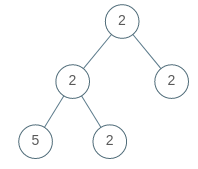
Input: root = [2,2,2,5,2]
Output: false
Constraints:
- The number of nodes in the tree is in the range
[1, 100]. 0 <= Node.val < 100
submission
// Definition for a binary tree node.
// #[derive(Debug, PartialEq, Eq)]
// pub struct TreeNode {
//   pub val: i32,
//   pub left: Option<Rc<RefCell<TreeNode>>>,
//   pub right: Option<Rc<RefCell<TreeNode>>>,
// }
//
// impl TreeNode {
//   #[inline]
//   pub fn new(val: i32) -> Self {
//     TreeNode {
//       val,
//       left: None,
//       right: None
//     }
//   }
// }
use std::rc::Rc;
use std::cell::RefCell;
impl Solution {
    pub fn is_unival_tree(root: Option<Rc<RefCell<TreeNode>>>) -> bool {
        fn dfs(root: &Option<Rc<RefCell<TreeNode>>>, val: i32) -> bool {
            root.as_ref().is_none_or(|node| {
                let node = node.borrow();
                node.val == val && dfs(&node.left, val) && dfs(&node.right, val)
            })
        }
        root.as_ref().is_none_or(|node| {
            let node = node.borrow();
            dfs(&node.left, node.val) && dfs(&node.right, node.val)
        })
    }
}