0042 - Trapping Rain Water
problem
Given n non-negative integers representing an elevation map where the width of each bar is 1, compute how much water it can trap after raining.
Example 1:
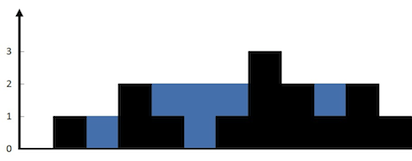
Input: height = [0,1,0,2,1,0,1,3,2,1,2,1]
Output: 6
Explanation: The above elevation map (black section) is represented by array [0,1,0,2,1,0,1,3,2,1,2,1]. In this case, 6 units of rain water (blue section) are being trapped.
Example 2:
Input: height = [4,2,0,3,2,5]
Output: 9
Constraints:
n == height.length1 <= n <= 2 * 1040 <= height[i] <= 105
submission
// for detailed explanation, see: https://leetcode.com/problems/trapping-rain-water/solutions/6563751/an-optical-approach-to-the-water-trapping-problem/

impl Solution {
    pub fn trap(height: Vec<i32>) -> i32 {
        let f_scan = |max: &mut i32, val: &i32| {
            *max = std::cmp::max(*max, *val);
            Some(*max)
        };

        let a_l: i32 = height.iter().scan(0, f_scan).sum(); // O(n)

        let a_r: i32 = height.iter().rev().scan(0, f_scan).sum(); // O(n)

        let a_landscape: i32 = height.iter().sum(); // O(n)
        let max_height = *height.iter().max().unwrap(); // O(n)
        let a_box = max_height * height.len() as i32;

        (a_l + a_r) - (a_box + a_landscape)
    }
}